
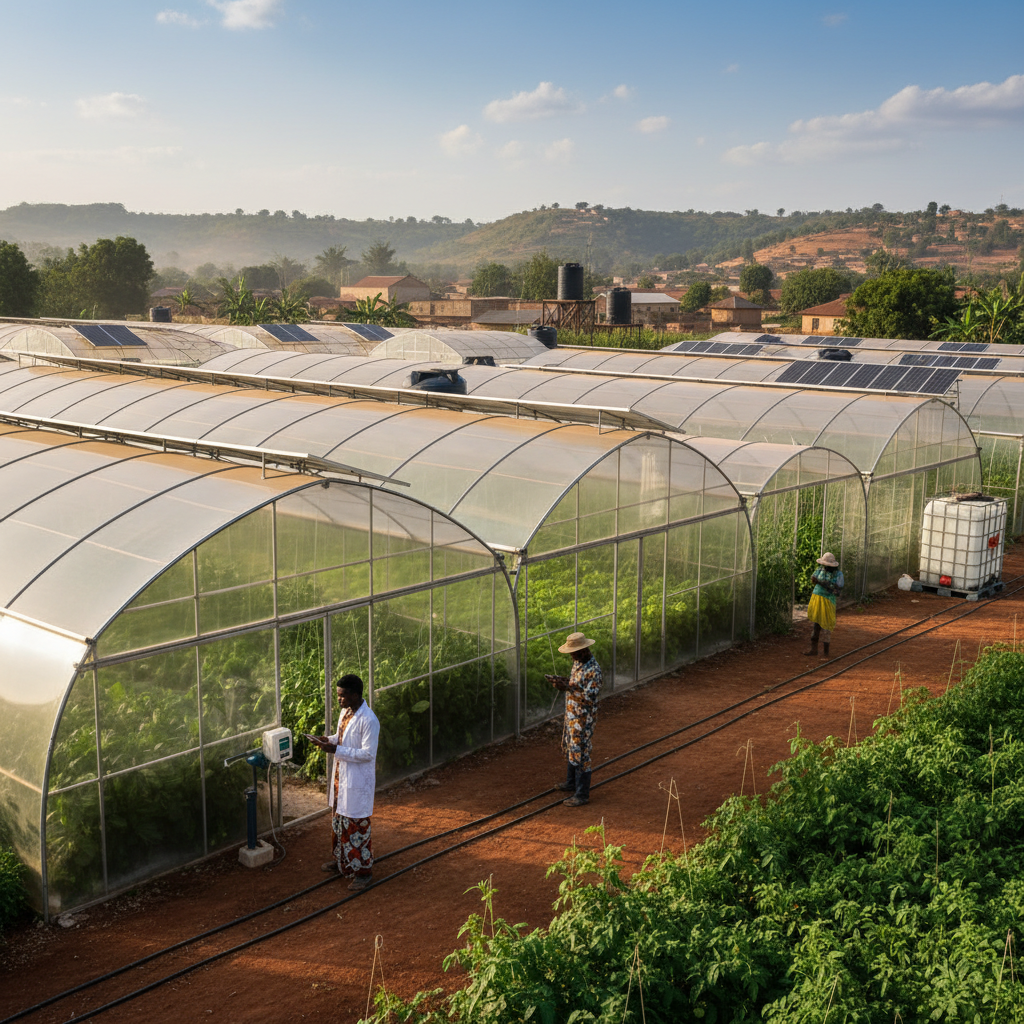
The Future of Greenhouse Vegetable Farming in Ghana
Why controlled environment agriculture is the key to year-round production and higher profitability in West Africa.
Stand at the entrance of a well-managed greenhouse in the Accra plains and the contrast is immediate. Outside, the harmattan dust and unpredictable rainfall dictate what can be grown and when. Inside, rows of trellised tomatoes or sweet peppers grow in clean, stable conditions, drip-fed with calibrated nutrients and largely untouched by the fungal diseases that routinely devastate open-field crops during the rainy season. This is not a vision of what might be possible someday. It is happening in Ghana right now.
Controlled Environment Agriculture (CEA), which most people know simply as greenhouse farming, is nothing new globally. The Netherlands has taken it to an industrial scale, producing more tomatoes per hectare than almost anywhere on earth despite a climate that is distinctly not tropical. What is changing across West Africa is the pace at which farmers, investors, and agribusinesses are taking it seriously, driven by rising urban food demand, the push for export-quality produce, and a steady decline in the cost of greenhouse structures.
Why This Moment Makes Sense for Ghana
Ghana's food system has a quiet but significant problem. The urban middle class is growing fast, and its demand for consistent, high-quality vegetables is outpacing what the domestic open-field sector can reliably supply. Accra's supermarkets and hotels import substantial volumes of tomatoes, bell peppers, cucumbers, and salad leaves from the Netherlands, Morocco, and South Africa. These are products that Ghanaian farmers are entirely capable of producing, given the right infrastructure and technical support.
The export picture is equally compelling. Ghana sits close to the Gulf states, which import the vast majority of their vegetables. A well-run Ghanaian greenhouse operation producing GlobalGAP-compliant produce at consistent quality can compete directly with Egyptian, Moroccan, and Kenyan suppliers. Consistency is the operative word, and it is precisely what a controlled environment delivers.
- Year-round production that is independent of rainfall patterns and dry seasons
- Yields per square metre that significantly exceed open-field equivalents
- Reduced pesticide use because most insects and diseases are physically excluded
- Predictable harvest timing that makes forward contracts with buyers possible
- Produce with uniform sizing, colour, and shelf life that commands premium prices in export markets
Choosing the Right Crops for Your Greenhouse
Not every crop performs equally well in greenhouse conditions, and the right choice depends on your market, your water supply, and how much you are prepared to invest in cooling. Ghana's climate is warm enough that passive ventilation (roll-up sides and ridge vents) works well for most crops, which keeps setup costs considerably lower than the heavily climate-controlled systems used in colder countries.
Fruiting Vegetables
Tomatoes, cucumbers, sweet peppers, and hot peppers are the most reliable performers in West African greenhouses. They respond well to drip irrigation and fertigation (fertiliser delivered directly through the irrigation system), and they carry strong prices in both domestic and export markets. In our managed greenhouse projects at PEA Agro, tomato and pepper production has consistently yielded two to three times more per hectare than equivalent open-field plots.
Salad Crops and Fresh Herbs
There is real and growing demand in Accra, Kumasi, and other major cities for fresh salad leaves, lettuce, basil, and coriander. Hotels, restaurants, and health-conscious shoppers are willing to pay well for locally grown produce with minimal pesticide use. The short growing cycles of most salad crops also mean faster returns on investment compared to fruiting vegetables.
Specialty Fruits
A small but growing number of operators in Ghana are experimenting with strawberry production under cover, particularly at higher altitudes where nighttime temperatures are lower. It requires more careful variety selection and closer management, but the potential is significant. Ghana currently imports virtually all its strawberries, which means a local producer entering that market faces almost no domestic competition.
The question I ask every potential greenhouse farmer is not whether they can grow a particular crop. Of course they can. The real question is who will buy it, at what price, and in what volume. Start with the market and build the production system around it.
Paulson Ahedor, Lead Consultant, PEA Agro Consult
What Does a Greenhouse Actually Cost?
The most common misconception about greenhouse farming is that it is unaffordable for most operators. The truth is that costs vary widely depending on the structure type, the level of technology involved, and the scale of the project.
At the basic end, a simple walk-in tunnel greenhouse built from polythene sheeting over a galvanised steel frame provides meaningful protection from rain, insects, and temperature swings at a relatively modest per-square-metre cost. At the other extreme, a full Dutch-style Venlo glasshouse with automated climate control, hydroponics, and supplemental lighting is a different proposition entirely, and appropriate only for large commercial operations with guaranteed export contracts in place.
For most of our clients, we recommend a middle path: a well-ventilated, insect-netted semi-shade structure with a drip irrigation system and basic fertigation capability. This setup delivers the core benefits of controlled environment farming (protection, irrigation precision, and pest exclusion) at a cost that is typically recoverable within one to three growing seasons for high-value crops.
Budget items that are easy to underestimate
Beyond the structure, a realistic greenhouse budget should include the drip irrigation system, seedling procurement or production, growing media (coco peat and perlite are widely used in Ghana), a fertiliser programme, post-harvest handling infrastructure such as washing, grading and cold storage, and ongoing technical management. First-time operators most often underestimate those last two. Quality post-harvest handling is what converts good production into a product buyers will actually pay for.
Why Technical Management Determines Success or Failure
The best greenhouse structure in West Africa will still fail commercially if the technical management is weak. Greenhouse farming is intensive. Crops grow at high density, share a restricted root zone, and depend on a continuous and precisely calibrated nutrient supply. A breakdown in the irrigation system, an undetected disease outbreak, or an incorrect EC (electrical conductivity) reading in the nutrient solution can destroy a crop within days.
PEA Agro structures its greenhouse management service as an ongoing partnership rather than a one-off consultation. We work with farmers to build crop calendars, nutrient management programmes, integrated pest management plans, and weekly monitoring routines. Our team conducts regular on-farm visits and provides detailed weekly reports covering plant health, yield projections, and any issues that need attention. Clients who engage at this level consistently outperform those who treat the greenhouse as a passive investment.
Getting Your Produce to Market
The best agronomist cannot help you if your produce has nowhere to go. Before any greenhouse project begins, the marketing question needs a real answer. Who will buy your produce? At what price, in what volume, and to what quality specification? Will you sell fresh or add value through processing or packaging? What certifications do your target buyers require?
PEA Agro operates across the full value chain, which is something few consultancies in Ghana can genuinely claim. Our team in Qatar and our broader network of international buyers means we can often identify a committed market before a greenhouse is even constructed, and then build the production system around what that market actually needs. Starting from the buyer and working backwards fundamentally reduces the risk of the investment.
Start with the right guidance
PEA Agro Consult provides full-service greenhouse setup and ongoing management. From site assessment and structure procurement to crop management, certification support, and buyer introductions, we work with you at every stage. Book a consultation to explore what greenhouse farming could realistically deliver for your operation.
Ready to put this into practice?
PEA Agro Consult's team of experts is ready to guide your agribusiness — from certification and greenhouse setup to market entry and commodity aggregation. Let's build something remarkable together.